
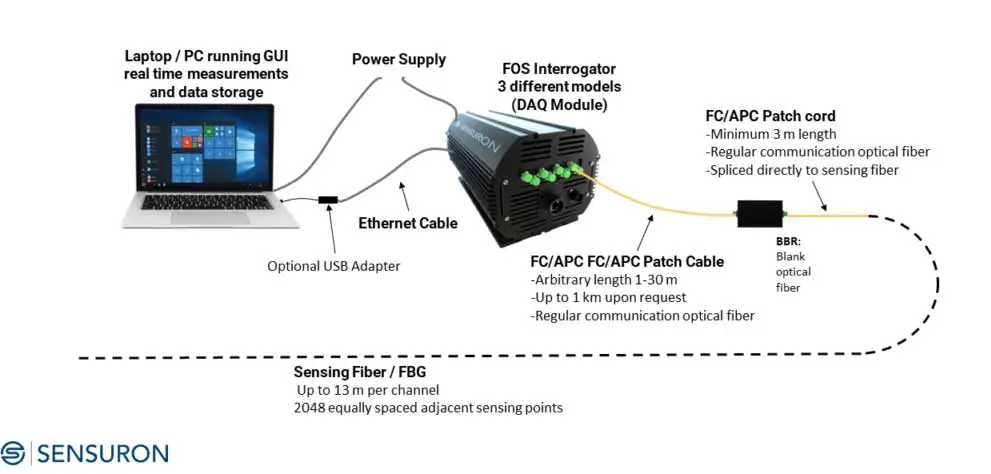
Modern engineering and research demands accurate monitoring of physical factors to assure safety and efficiency. Optical Fiber Sensors are revolutionizing the way engineers monitor strain and temperature in real time and provide precise data. They sense subtle variations along their length, such that thousands of points of sensing can be monitored without modifying the structure. Their small size enables them to be installed discreetly, and hence they are suitable for use in not only civil infrastructure but also in aerospace structures and laboratory research projects that demand precision.
Understanding the Science Behind Fiber Sensors
How Light Interacts with Fiber
The fiber sensors are operated based on the behavior of light in a length of optical fiber. Minor changes in temperature or mechanical stress change the light wavelength. An interrogator captures these changes and transforms them into specific measurements. This is done using non-electrical methods to ensure that the sensors are not susceptible to any electromagnetic interference and can therefore be used in areas where electronic forms of instrumentation may not be possible.
Types of Sensing Methods
Optical fiber systems have a number of techniques applied. Fiber Bragg gratings (FBGs) reflect specific wavelengths that shift in response to environmental changes. In distributed sensing, scattering effects are used to offer continuous monitoring of the entire fiber length. Both approaches provide varying degrees of sensitivity and spatial resolution, and can be tailored to applications such as tunnel supervision, bridge surveys, or composite material studies.
Applications in Structural Health Monitoring
Bridges and Large Structures
Placing optical fiber sensors in a bridge or crossing allows engineers to monitor stress patterns, detect cracks, and keep track of weight distribution over time. This real-time information gives engineers valuable insights into structural integrity and has aided in averting unexpected collapses.
Buildings and Construction Projects
The sensors may be installed during construction and used to monitor important load-bearing components. The continuous strain measurement assists the engineers in proving a design assumption and where they could be of concern before it runs out of control. Such systems are particularly applicable to tall or compound structures where they are hard or unsafe to check manually.
Aerospace and Mechanical Testing
Aircraft Structural Monitoring
In aerospace engineering, composite materials are fitted with optical fibers that are able to identify strain and deformation both in testing and operational stages. These measurements are used to validate performance models, meet safety standards, and make design changes to reduce weight and increase durability.
Machinery and Engine Components
Fiber sensors are useful in mechanical systems for dynamic testing. Monitoring strain and temperature variations, engineers have access to understanding fatigue, wear, or areas where failures may occur. This will enable better designs and informed proactive maintenance schedules.
Environmental and Research Applications
Energy Sector Monitoring
Optical sensors are also being increasingly utilized to track pipelines, wind turbines, and electrical power structures. Sensing fibers can be used to detect changes in temperature or strain since they’re not affected by electrical interference and can they be used over long distances.
Laboratory and Scientific Research
Optical fibers are also used in research labs where scientists can measure the presence of minute temperature and strain changes. The sensors are small and lightweight, so they can be incorporated into an experimental system without affecting the structure being studied. They provide more precise results because they are flexible and can be embedded into the system.
Why Choose Sensuron?
We provide advanced sensors designed for accurate, real-time monitoring across a wide range of applications. Our systems provide high-resolution distributed strain and temperature information. We design sensing solutions to be effective in harsh conditions. By choosing Sensuron, you get access to quality technology and professional service.
Conclusion
Optical Fiber Sensors are revolutionizing the way structures, machinery, and environments are monitored by providing detailed, real-time, and highly accurate measurements. They are valuable in the fields of advanced engineering, scientific research, and environmental monitoring because of their ability to collect comprehensive data reliably over long distances. The increased use of such systems is making designs safer and providing better understanding of complex structures.