
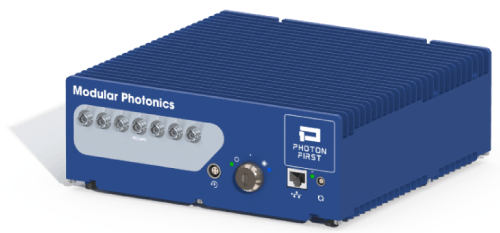
Recent developments in optical sensing are changing the way engineers and scientists are monitoring complex infrastructure, industrial systems, and critical environments. The core of most of these breakthroughs is the Fiber Bragg Grating Interrogator, a complex device that transforms variations in the light that is reflected back by the fiber sensors into accurate real-time information. This technology uses minute periodic fluctuations in optical fibers, which serve as mirrors of certain wavelengths and allow measurement of strain or temperature along a fiber with precision.
How Fiber Bragg Grating Interrogator Technology Works
Every grating reflects a band of light, whereas the other bands are transmitted. As the fiber is stretched, heated, or compressed, the distance between the grating varies, and this changes the wavelength reflected.
It is the task of the interrogator to identify these variations of reflected wavelengths with a high degree of resolution. The interrogator has an optical source that emits the broadband light, which passes through the fiber network. The signal reflected off each grating is reflected to the interrogator, where small changes in wavelength are detected using sensitive optics and detectors. Such alterations are converted to high-powered algorithms, which change them into precise measurements of physical phenomena.
This technique can measure hundreds or thousands of points along the fiber simultaneously. It also does not require any electrical connection at the sensing points, so it is more durable and can be easily deployed in adverse or remote environments.
Key Advantages of Fiber Bragg Grating Interrogator Systems
• High Precision and Stability
The interrogators provide great accuracy of measurements in the long term. Their capability to discern any minute changes in wavelengths qualifies them for applications that demand precision, such as the structural health of bridges or aircraft components.
• Electromagnetic Immunity
These systems are immune to electromagnetic interference because they use light instead of electrical signals. This renders them ideal for high electrical noise environments or where electrical sensors are unsafe.
• Multiplexing Flexibility
Sensors in the form of FBG can be installed at closely spaced distances along a single fiber. All the gratings reflect different wavelengths and this enables the interrogator to identify and measure numerous sensors simultaneously.
• Durability in Harsh Conditions
Optic sensors are lightweight, do not corrode, and can withstand extreme temperatures. Combined with rugged interrogators, they are used in oil and gas, power generation, and aerospace applications.
Applications Driving Modern Innovation
The flexibility of the interrogators allows them to be applied to:
• Structural Health Monitoring
Constant stress and strain in bridges, tunnels, dams, and buildings are challenging for any sensing system. Structural Health Monitoring interrogators measure deformation or instability of objects and enable preventive maintenance.
• Energy Sector Insights
Optical sensing can be used in wind turbines, power plants, and pipelines to give vital data in severe circumstances. Interrogators help monitor vibrations, temperature gradients, and structural fatigue without interrupting operations.
• Aerospace and Transportation
The loads and temperatures of aircraft wings, fuselages, and train tracks are dynamic. Optical sensing provides real-time feedback to the engineers, enhancing design, performance, and maintenance scheduling.
• Industrial Automation and Manufacturing
High-speed, precise measurement systems are frequently needed in precision manufacturing environments. This grating technology provides the quality control required for repeatability and reliability.
Choosing the Right Interrogator for Your Needs
In the process of choosing a suitable interrogator, one needs to know the sensor requirements and the environment in which the interrogator would be used. Key considerations include:
• Wavelength Range and Resolution – It defines the number of sensors that can be read and the accuracy of the measurements.
• Sampling Rate – Dynamic measurements like vibration analysis need higher sampling rates.
• Environmental Tolerance – Outdoor and industrial environments have to endure extremes of temperature, water, and physical pressures.
• Data Integration Capabilities – Real-time analytics and decision-making are improved through connectivity with control systems and cloud platforms.
Why Choose Sensuron?
Sensuron provides reliable and performance-based sensing solutions based on advanced monitoring requirements. Our interrogator systems offer accurate measurements, constant operation, and easy integration. We prioritize strong design, state-of-the-art data processing, and durability. We provide our knowledge to ensure that we can assist our customers to gain precise measurements in challenging applications.
Conclusion
The Fiber Bragg Grating Interrogator is a solution at the forefront of current sensing options through unmatched precision, reliability, and scalability of the system in various applications. The fact that it can transform sensitive optical signals into data that can be acted upon is what has made it an indispensable tool in industries that need real-time information and a high level of functionality. With ever-changing infrastructure and the increasing complexity of systems, these interrogation systems are an increasingly important part of efforts to provide enhanced safety and innovation.