
Civil engineering has always carried a certain weight, not just structurally, but in the pressure to get answers fast without compromising accuracy. Bridges, tunnels, and large-scale infrastructure projects can’t afford slow validation cycles or patchy stress data. Yet traditional strain gauges and manual setups keep doing exactly that: dragging out timelines and missing the kind of real-world behavior that actually matters. Fiber Optic Sensors are changing that equation, giving engineers a genuinely smarter way to evaluate structural performance as it happens.
At Sensuron, we’ve seen what happens when data gaps hit at the wrong moment in a testing phase, decisions get delayed, assumptions fill the void, and risk quietly accumulates. Conventional methods were never really built for the complexity of today’s load scenarios and dynamic environments. Our sensing approach cuts through that. Instead of snapshots and workarounds, engineers get continuous, reliable structural data, the kind that keeps infrastructure projects on track and grounded in what the structure is actually doing.
Why Do Traditional Civil Engineering Testing Methods Slow Down Projects?
Civil engineering testing runs into delays more often than it should, and conventional sensor-based systems are largely why. Bridge and tunnel validation hasn’t changed much in practice; the same older methods still dominate, and a look at the Fiber Optic Sensing Overview gets to the heart of why that’s a problem. Manual processes pile up, measurement coverage stays patchy, and somewhere in that combination, project timelines and testing efficiency both take a hit.
- Strain gauge and accelerometer installation is done by hand, pushing back the start of actual testing.
- A fixed number of sensing points means full structural visibility across large or complex assets isn’t achievable.
- Recalibration between test cycles adds up, slowing iterative validation work.
- Heavy labor dependency makes setup and teardown slow and difficult to scale.
- During dynamic loading, data gaps can miss the structural behavior that matters most.
At Sensuron, we address these friction points by enabling continuous, high-resolution sensing that simplifies workflows and improves testing speed.
Ultimately, traditional methods don’t slow projects down because engineers lack skill. They slow things down because sensing coverage is too thin and manual dependency runs too deep.
Limitations of Conventional Structural Testing in Civil Engineering
Civil engineering testing loses time in predictable ways. Installing strain gauges and accelerometers one by one drives up setup complexity and labor, and once they’re in place, the coverage is still limited; point-based measurements leave large sections of a structure effectively unmonitored. What gets missed in those gaps matters.
Recalibration between test cycles makes things worse. During repeated load testing, those interruptions break the continuity of data collection and stretch out validation phases that are already under schedule pressure. Engineers end up piecing together an incomplete picture of how a structure actually behaves under real-world dynamic conditions, which slows the whole workflow down.
Sensuron approaches this differently. Our Fiber Optic Sensors replace scattered point measurements with continuous distributed sensing across the full structure. There’s no repeated setup between cycles, no blind spots in the data. Engineers get faster turnaround, more consistent results, and the resolution needed to genuinely understand structural behavior, which is what civil engineering testing efficiency is supposed to look like.
How Does Fiber Optic Sensing Improve Data Accuracy in Structural Testing?
Structural evaluation is only as good as what the sensors actually catch. Traditional systems miss subtle shifts that matter, and by the time those gaps show up, decisions have already been made on incomplete data. Modern sensing gives engineers a fundamentally clearer view during testing.
Thousands of Measurement Points
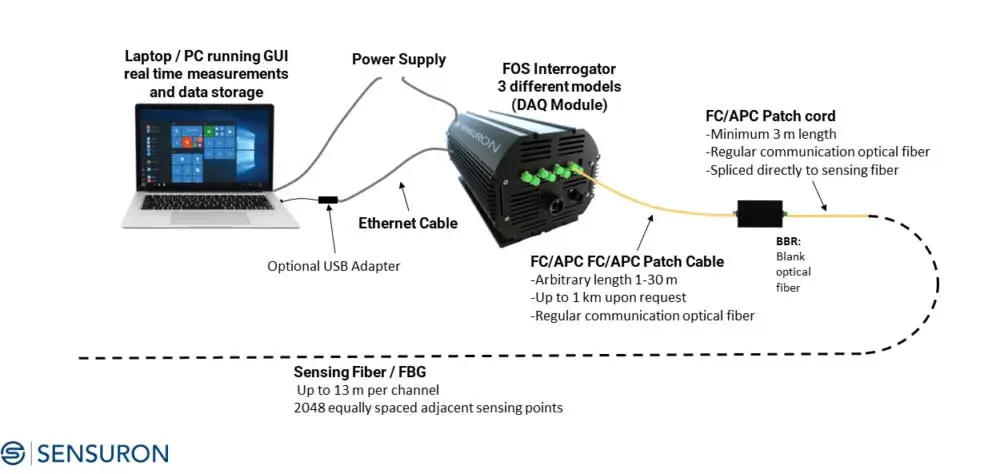
One sensing line covers thousands of points simultaneously, building a continuous picture of how a structure is behaving. The blind spots that conventional point-based setups leave behind simply don’t exist here.
High Spatial Precision
Fine spatial resolution picks up micro-level deformations early, the kind that signal stress patterns well before anything visible develops. Engineers get the lead time to act on what the data is showing, not react to what’s already failed.
Cleaner Real-Time Signals
Strain and temperature effects are separated at the source, and electrical noise is reduced before it can distort readings. The result is a dataset engineers can actually trust for predictive structural analysis and long-term safety modeling.
Transformation of Civil Engineering Testing Workflows
Civil engineering testing is changing in ways that are hard to ignore. Real-time systems cut iteration cycles, reduce manpower dependency, and enable continuous monitoring for predictive insights. Fiber Optic Sensors strengthen safety validation and data-driven decisions, and advanced DFOS platforms like Sensuron bring scalability and digital twin integration within reach.
Modern civil engineering is moving toward faster, safer, and more reliable evaluation. At Sensuron, our Fiber Optic Sensing approach helps engineers get clearer insights and smoother workflows, with better infrastructure outcomes on the other side. Connect with us to see what smarter testing looks like.
Frequently Asked Questions
How do engineers monitor structural performance in real time during testing?
Fiber Optic Sensing Overview covers how optical fibers track strain and temperature as testing happens, giving engineers the accuracy, efficiency, and safety data they actually need to make confident decisions.
How do distributed sensing systems differ from traditional sensors?
Traditional sensors measure at fixed points and leave everything in between unaccounted for. Distributed systems capture data continuously along the full length of a fiber, producing a far more complete picture of structural behavior.
How do Fiber Optic Sensors improve testing efficiency?
Setup is faster, test cycles run quicker, and data flows continuously throughout. The combined effect is a meaningful improvement in both speed and accuracy across engineering evaluations.
Can these systems be used in harsh environments?
They’re built for it. High temperatures, electrical noise, physically demanding conditions- these systems are designed to hold up and keep delivering reliable data where conventional sensors struggle.
How does Sensuron support civil engineering applications?
We provide sensing systems that deliver real-time structural insights engineers can act on, helping teams reach higher accuracy and better outcomes without the limitations of conventional testing approaches.