
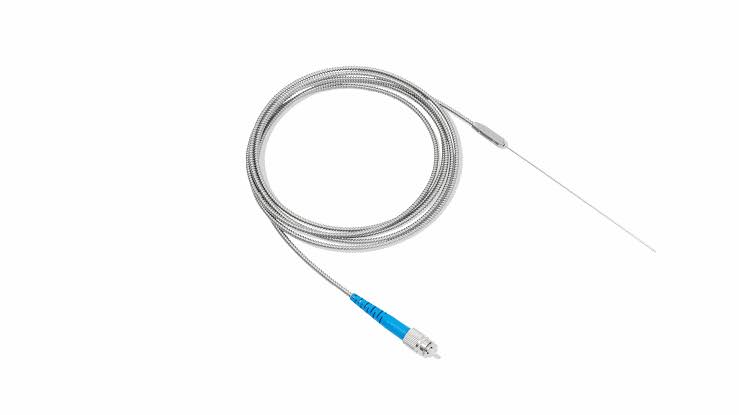
Medical device instrumentation engineers often need strain and force measurements without adding bulk, electrical wiring or unwanted electromagnetic interference. The choice between optical and electrical sensing becomes especially important in surgical robotics, minimally invasive instruments and MRI environments. An FBG sensor can provide point-based optical measurement while allowing multiple sensing points on a single fiber. The right choice depends on your device requirements, including size, sampling rate, electrical isolation, environmental conditions and integration space.
What Is an FBG Sensor?
An FBG sensor is a Fiber Bragg Grating written into the core of an optical fiber. The grating reflects a specific wavelength of light, known as the Bragg wavelength. When the fiber experiences strain or temperature changes, the grating spacing changes and shifts the reflected wavelength. An optical interrogator detects that shift and converts it into measurement data.
For medical devices, this gives you a compact point-sensing option without placing electrical current at the sensing location. Multiple sensing points can also be multiplexed along one fiber, reducing the wiring required around compact instruments.
FBG Sensors vs. Electrical Strain Gauges: What Changes?
The differences become clearer when you evaluate the technologies against common medical device requirements.
| Evaluation factor | Electrical strain gauges | Fiber Bragg Grating sensor | Medical device consideration |
| Wiring | Individual electrical leads | Multiple sensors can share one fiber | Less cabling around compact instruments |
| EMI | Susceptible to electrical interference | Immune to EMI/RFI | Useful around MRI and electronic equipment |
| Size | Gauge plus lead wires | Fiber can be as small as 200 µm | Supports narrow instruments |
| Electrical path | Conductive | Non-conductive optical path | Important for patient-facing devices |
| Dynamic measurement | Depends on acquisition hardware | Up to 19.2 kHz on one channel | Supports high-speed sensing applications |
How Can You Integrate Miniature Optical Interrogators Into Medical Consoles?
Compact interrogation hardware can make optical sensing easier to incorporate into enclosed OEM equipment. Our GTR FBG interrogator measures 100 × 114 × 35 mm, weighs 310 grams and operates below 10 W, with approximately 5 W consumption at 25°C. It also supports a mezzanine interface concept and USB 2.0 connectivity.
For an Original Equipment Manufacturer (OEM) engineer working with limited enclosure space, those specifications matter before mechanical integration begins. Sensuron’s GTR also provides single-channel sampling up to 19.2 kHz and supports up to eight optical sensors, giving you high-speed measurement capability in a compact platform.
How Are High-Speed Optical Measurements Used in Medical Devices?
High-speed measurement can support several medical applications where conventional electrical sensing creates practical constraints.
- Surgical robotics: Force-tip sensing and haptic feedback can benefit from sampling rates up to 19.2 kHz on a single channel.
- Minimally invasive instruments: Small optical fibers can fit into narrow catheters, endoscopes and other instruments where cable size matters.
- MRI environments: Non-conductive fibers avoid an electrical signal path and provide immunity to electromagnetic interference.
- Device positioning: Optical sensing can support measurement of instrument movement and position.\
Sensuron provides interrogators and optical sensing equipment for these measurement requirements, with applications spanning medical instrumentation and minimally invasive procedures.
How Can Optical Sensors Account for Temperature Changes?
Temperature matters whenever you are using an optical strain measurement in an environment where thermal conditions can change. A wavelength shift can result from mechanical strain, temperature or both, so the measurement system must account for the parameter being measured. Strain-sensing fibers and temperature-sensing fibers can be used together to account for thermal effects during measurement. This helps engineers distinguish changes caused by temperature from those caused by mechanical strain when operating conditions vary.
Choosing the Right Interrogator for Your Device
Your interrogator choice should follow the sensing requirements of the medical device.
- GTR: Compact OEM integration, one optical channel, up to eight sensors and up to 19.2 kHz sampling.
- SGTR: Desktop platform with up to eight optical channels, up to 64 total sensors and 19.2 kHz single-channel sampling.
- AGTR-NEO: Eight-channel aerospace-qualified platform with IP65 protection, onboard storage and 19.2 kHz single-channel sampling.
As the manufacturer and provider of Distributed Fiber Optic Sensing systems, we supply the interrogation hardware and sensing capabilities needed to turn these measurement requirements into practical systems.
Choosing Optical Sensing for Medical Devices
For medical device engineers, Micro-optical strain transducer technology can offer compact sensing, photonic isolation, and high-speed measurement where electrical gauges may create limitations. FBG sensors vs electrical strain gauges become most useful as an engineering comparison when size, EMI, electrical isolation and dynamic response affect the device design.
FAQs
Why are FBG sensors useful for haptic force feedback in surgical robotics?
Optical Bragg grating sensors can support force-tip sensing and haptic feedback in surgical robotics. Their design enables responsive force measurement while avoiding the electrical interference associated with conventional sensing technologies.
How does the Sensuron GTR fit into compact medical equipment?
Our GTR measures 100 × 114 × 35 mm, weighs 310 grams and operates below 10 W. The compact package supports OEM integration where enclosure space, power consumption and thermal output must be considered.
How can FBG optical sensors account for temperature changes during measurement?
We provide dedicated strain and temperature sensing fibers, including ORMOCER and ORMOCER-T options. Measuring temperature alongside strain helps engineers distinguish thermal effects from mechanical changes when operating conditions vary.