
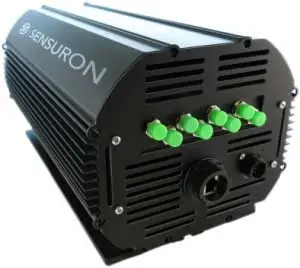
Engineers rely on temperature data for tests, monitoring, and product development, and a few scattered readings rarely tell the whole story. So what can a Fiber Optic Temperature Sensor show that conventional readings can’t? It reveals how temperature shifts across an entire component or structure. At Sensuron, we build distributed fiber optic sensing technology for complex structures and tough test environments where detail matters.
Picking a Fiber Optic Temperature Sensor takes more than checking its temperature range. Engineers also have to weigh measurement coverage, spatial resolution, response time, environmental conditions and how well the system fits their setup. Sorting through those factors shows whether fiber optic sensing suits a given project and supports better decisions during testing, monitoring, and design validation.
Choosing a Fiber Optic Temperature Sensor for Your Application
The right sensor depends on the structure you’re testing and the temperature changes you need to see. Before you select a system, evaluate these factors.
| Selection factor | What to evaluate | Why it matters |
| Measurement coverage | Point-based or distributed measurements | Tells you whether you can examine temperature variations between measurement locations. |
| Spatial resolution | Distance between measurement points | Helps you spot localized temperature changes across a component. |
| Temperature range | Expected minimum and maximum temperatures | Confirms the system suits your testing conditions. |
| Response time | Speed of temperature changes | Shows whether the system can capture changes at the rate you need. |
| Installation requirements | Fiber placement, access and equipment compatibility | Helps you judge whether the system can be integrated into your test setup. |
Pick your Optical Fiber Temperature Sensor by what the job demands, not by what the spec sheet says. A system only works if its measurement method fits the application and what your tests are meant to show.
How Distributed Sensing Addresses Measurement Gaps
A point-based sensor only reports the spot where it’s mounted, so anything happening between spots goes unnoticed. Fiber Optic Temperature Sensing fills that gap by reading along the full length of the sensing fiber. Engineers get a continuous view of temperature across a test area.
Composite Materials
During material testing, fiber optic sensing reveals where heat spreads and where it builds up across a composite specimen, which helps teams study temperature variations in far more detail.
Aerospace Components
In aerospace engineering tests, engineers can track how temperature changes along a component’s length, which a handful of separate readings would never show them.
Energy Systems
Distributed measurements make it easier to monitor temperature distributions in relevant energy equipment, helping operators notice thermal patterns that isolated sensors could miss entirely.
Industrial Testing
Examine thermal changes across components and surfaces during testing, and get measurements showing exactly how temperature varies across the whole test area you’re investigating.
Understanding Sensuron’s Sensing Capabilities
Our distributed fiber optic sensing systems at Sensuron provide spatially continuous measurements along an optical fiber. Depending on the platform you choose, engineers can measure temperature or strain, which gives a fuller picture of material and structural behavior.
Evaluate any Optical Fiber Temperature Sensor system as part of the complete measurement setup. The interrogator, sensing fiber, software and installation method all affect how data is collected and interpreted. When comparing, check channel count, spatial resolution and measurement speed.
Decide whether you need temperature and strain together and whether the system suits laboratory testing or demanding field environments. Our RTS125+ and other distributed sensing platforms offer different capabilities for engineering applications. Reviewing their specifications helps you find the configuration that matches your measurement needs.
Questions to Ask Before Selecting a System
Before you commit to a sensing solution, define what the project needs to measure and how you’ll use the results.
Ask yourself:
- Do you need continuous measurements or are readings at selected points enough?
- How fast can temperature change during testing?
- What spatial resolution do you need to catch the relevant variations?
- Do environmental or installation constraints limit where sensors can go?
Fiber Optic Temperature Sensing isn’t automatically the best choice for every project. Before committing, compare what the technology offers against your measurement goals, so you know whether it truly matches what the test demands.
Budget and integration needs deserve the same scrutiny. Weigh them alongside capabilities, and you’ll see whether the system fits your setup, your timeline, and your resources, or whether another approach serves you better.
Conclusion
Choosing a Fiber Optic Temperature Sensor starts with knowing what your engineering project needs to measure. At Sensuron, our distributed sensing systems help engineers examine temperature variations across complex structures. Review your coverage, resolution, response, and environmental requirements, and you’ll be in a good position to find a solution for your testing or monitoring application.
FAQs
1. How does distributed temperature sensing differ from point-based temperature measurement?
A point-based sensor only tells you the temperature at the spot where it sits. Distributed sensing reads along the whole length of an optical fiber, so you can see what’s happening between those spots and how heat behaves across an entire component or structure.
2. What should engineers check before choosing a temperature sensing system?
Start with temperature range, spatial resolution, and response time. Then look at measurement coverage, installation conditions, and how well the system works with your existing equipment. Run through those, and you’ll know quickly whether a solution fits your project.